Related Posts Plugin for WordPress, Blogger...

Showing posts with label Short Stories. Show all posts

Essence of Trust - A Moral Story


posted by Di-G on ,

1 comment

A Little girl and her father were crossing a bridge.
The father was kind of scared so he asked his little daughter,
"Sweetheart, please hold my hand so that you don't fall into the river."

The little girl said, "No, Dad. You hold my hand."

"What's the difference?'"asked the puzzled father.
"There's a big difference," replied the little girl. 'If I hold your hand and something happens to me, chances are that I may let your hand go but if you hold my hand, I know for sure that no matter what happens, you will never let my hand go.' ♥

In any relationship, the essence of trust is not in its bind, but in its bond. So hold the hand of the person you love rather than expecting them to hold yours.

This message is too short...... but carries a lot of Feelings.

Sword Of Damocles (Short Story)


posted by Di-G on

3 comments


There was once a king whose name was Dionysius. He was so unjust and cruel that he won for himself the name of tyrant. He knew that almost everybody hated him, and so he was always in dread lest some one should take his life.

But he was very rich, and he lived in a fine palace where there were many beautiful and costly things, and he was waited upon by a host of servants who were always ready to do his bidding. One day a friend of his, whose name was Damocles, said to him,--

"How happy you must be! You have here everything that any man could wish."

"Perhaps you would like to change places with me," said the tyrant.

"No, not that, O king!" said Damocles; "but I think, that, if I could only have your riches and your pleasures for one day, I should not want any greater happiness."

"Very well," said the tyrant. "You shall have them."

And so, the next day, Damocles was led into the palace, and all the servants were bidden to treat him as their master. He sat down at a table in the banquet hall, and rich foods were placed before him. Nothing was wanting that could give him pleasure. There were costly wines, and beautiful flowers, and rare perfumes, and delightful music. He rested himself among soft cushions, and felt that he was the happiest man in all the world.

Then he chanced to raise his eyes toward the ceiling. What was it that was dangling above him, with its point almost touching his head? It was a sharp sword, and it was hung by only a single horse-hair. What if the hair should break? There was danger every moment that it would do so.

The smile faded from the lips of Damocles. His face became ashy pale. His hands trembled. He wanted no more food; he could drink no more wine; he took no more delight in the music. He longed to be out of the palace, and away, he cared not where.

"What is the matter?" said the tyrant.

"That sword! that sword!" cried Damocles. He was so badly frightened that he dared not move.

"Yes," said Dionysius, "I know there is a sword above your head, and that it may fall at any moment. But why should that trouble you? I have a sword over my head all the time. I am every moment in dread lest something may cause me to lose my life."

"Let me go," said Damocles. "I now see that I was mistaken, and that the rich and powerful are not so happy as they seem. Let me go back to my old home in the poor little cottage among the mountains."

And so long as he lived, he never again wanted to be rich, or to change places, even for a moment, with the king.


James Baldwin's short story: Sword Of Damocles

Laconic Answer (Short Story)


posted by Di-G on

No comments


Many miles beyond Rome there was a famous country which we call Greece. The people of Greece were not united like the Romans; but instead there were several states, each of which had its own rulers.

Some of the people in the southern part of the country were called Spartans, and they were noted for their simple habits and their bravery. The name of their land was Laconia, and so they were sometimes called Lacons.

One of the strange rules which the Spartans had, was that they should speak briefly, and never use more words than were needed. And so a short answer is often spoken of as being _laconic_; that is, as being such an answer as a Lacon would be likely to give.

There was in the northern part of Greece a land called Macedon; and this land was at one time ruled over by a war-like king named Philip.

Philip of Macedon wanted to become the master of all Greece. So he raised a great army, and made war upon the other states, until nearly all of them were forced to call him their king. Then he sent a letter to the Spartans in Laconia, and said, "If I go down into your country, I will level your great city to the ground."

In a few days, an answer was brought back to him. When he opened the letter, he found only one word written there.

That word was "IF."

It was as much as to say, "We are not afraid of you so long as the little word 'if' stands in your way."


James Baldwin's short story: Laconic Answer

Damon And Pythias (Short Story)


posted by Di-G on

No comments


A young man whose name was Pythias had done something which the tyrant Dionysius did not like. For this offense he was dragged to prison, and a day was set when he should be put to death. His home was far away, and he wanted very much to see his father and mother and friends before he died.

"Only give me leave to go home and say goodbye to those whom I love," he said, "and then I will come back and give up my life."

The tyrant laughed at him.

"How can I know that you will keep your promise?" he said. "You only want to cheat me, and save yourself."

Then a young man whose name was Damon spoke and said,--

"O king! put me in prison in place of my friend Pythias, and let him go to his own country to put his affairs in order, and to bid his friends farewell. I know that he will come back as he promised, for he is a man who has never broken his word. But if he is not here on the day which you have set, then I will die in his stead."

The tyrant was surprised that anybody should make such an offer. He at last agreed to let Pythias go, and gave orders that the young man Damon should be shut up in prison.

Time passed, and by and by the day drew near which had been set for Pythias to die; and he had not come back. The tyrant ordered the jailer to keep close watch upon Damon, and not let him escape. But Damon did not try to escape. He still had faith in the truth and honor of his friend. He said, "If Pythias does not come back in time, it will not be his fault. It will be because he is hindered against his will."

At last the day came, and then the very hour. Damon was ready to die. His trust in his friend was as firm as ever; and he said that he did not grieve at having to suffer for one whom he loved so much.

Then the jailer came to lead him to his death; but at the same moment Pythias stood in the door. He had been delayed by storms and ship-wreck, and he had feared that he was too late. He greeted Damon kindly, and then gave himself into the hands of the jailer. He was happy because he thought that he had come in time, even though it was at the last moment.

The tyrant was not so bad but that he could see good in others. He felt that men who loved and trusted each other, as did Damon and Pythias, ought not to suffer unjustly. And so he set them both free.

"I would give all my wealth to have one such friend," he said.


James Baldwin's short story: Damon And Pythias

Arnold Winkelried (Short Story)


posted by Di-G on

No comments


A great army was marching into Switzerland. If it should go much farther, there would be no driving it out again. The soldiers would burn the towns, they would rob the farmers of their grain and sheep, they would make slaves of the people.

The men of Switzerland knew all this. They knew that they must fight for their homes and their lives. And so they came from the mountains and valleys to try what they could do to save their land. Some came with bows and arrows, some with scythes and pitch-forks, and some with only sticks and clubs.

But their foes kept in line as they marched along the road. Every soldier was fully armed. As they moved and kept close together, nothing could be seen of them but their spears and shields and shining armor. What could the poor country people do against such foes as these?

"We must break their lines," cried their leader; "for we cannot harm them while they keep together."

The bowmen shot their arrows, but they glanced off from the soldiers' shields. Others tried clubs and stones, but with no better luck. The lines were still unbroken. The soldiers moved steadily onward; their shields lapped over one another; their thousand spears looked like so many long bristles in the sunlight. What cared they for sticks and stones and huntsmen's arrows?

"If we cannot break their ranks," said the Swiss, "we have no chance for fight, and our country will be lost!"

Then a poor man, whose name was Arnold Winkelried, stepped out.

"On the side of yonder mountain," said he, "I have a happy home. There my wife and children wait for my return. But they will not see me again, for this day I will give my life for my country. And do you, my friends, do your duty, and Switzerland shall be free."

With these words he ran forward. "Follow me!" he cried to his friends. "I will break the lines, and then let every man fight as bravely as he can."

He had nothing in his hands, neither club nor stone nor other weapon. But he ran straight onward to the place where the spears were thickest.

"Make way for liberty!" he cried, as he dashed right into the lines.

A hundred spears were turned to catch him upon their points. The soldiers forgot to stay in their places. The lines were broken. Arnold's friends rushed bravely after him. They fought with whatever they had in hand. They snatched spears and shields from their foes. They had no thought of fear. They only thought of their homes and their dear native land. And they won at last.

Such a battle no one ever knew before. But Switzerland was saved, and Arnold Winkelried did not die in vain.

James Baldwin's short story: Arnold Winkelried

Androclus And The Lion —A Short Story


posted by Di-G on

No comments


James Baldwin's short story: Androclus And The Lion

In Rome there was once a poor slave whose name was Androclus. His master was a cruel man, and so unkind to him that at last Androclus ran away.

He hid himself in a wild wood for many days; but there was no food to be found, and he grew so weak and sick that he thought he should die. So one day he crept into a cave and lay down, and soon he was fast asleep.

After a while a great noise woke him up. A lion had come into the cave, and was roaring loudly. Androclus was very much afraid, for he felt sure that the beast would kill him. Soon, however, he saw that the lion was not angry, but that he limped as though his foot hurt him.

Then Androclus grew so bold that he took hold of the lion's lame paw to see what was the matter. The lion stood quite still, and rubbed his head against the man's shoulder. He seemed to say,--

"I know that you will help me."

Androclus lifted the paw from the ground, and saw that it was a long, sharp thorn which hurt the lion so much. He took the end of the thorn in his fingers; then he gave a strong, quick pull, and out it came. The lion was full of joy. He jumped about like a dog, and licked the hands and feet of his new friend.

Androclus was not at all afraid after this; and when night came, he and the lion lay down and slept side by side.

For a long time, the lion brought food to Androclus every day; and the two became such good friends, that Androclus found his new life a very happy one.

One day some soldiers who were passing through the wood found Androclus in the cave. They knew who he was, and so took him back to Rome.

It was the law at that time that every slave who ran away from his master should be made to fight a hungry lion. So a fierce lion was shut up for a while without food, and a time was set for the fight.

When the day came, thousands of people crowded to see the sport. They went to such places at that time very much as people nowadays go to see a circus show or a game of baseball.

The door opened, and poor Androclus was brought in. He was almost dead with fear, for the roars of the lion could already be heard. He looked up, and saw that there was no pity in the thousands of faces around him.

Then the hungry lion rushed in. With a single bound he reached the poor slave. Androclus gave a great cry, not of fear, but of gladness. It was his old friend, the lion of the cave.

The people, who had expected to see the man killed by the lion, were filled with wonder. They saw Androclus put his arms around the lion's neck; they saw the lion lie down at his feet, and lick them lovingly; they saw the great beast rub his head against the slave's face as though he wanted to be petted. They could not understand what it all meant.

After a while they asked Androclus to tell them about it. So he stood up before them, and, with his arm around the lion's neck, told how he and the beast had lived together in the cave.

"I am a man," he said; "but no man has ever befriended me. This poor lion alone has been kind to me; and we love each other as brothers."

The people were not so bad that they could be cruel to the poor slave now. "Live and be free!" they cried. "Live and be free!"

Others cried, "Let the lion go free too! Give both of them their liberty!"

And so Androclus was set free, and the lion was given to him for his own. And they lived together in Rome for many years.

▬▬▬▬▬▬▬▬▬▬▬▬
► An Informative Page ◄
▬▬▬▬▬▬▬▬▬▬▬▬

James Baldwin's short story: Admetus And Alcestis (from 'Old Greek Stories')


posted by Di-G on

No comments


James Baldwin's short story: Admetus And Alcestis (from 'Old Greek Stories')

I. THE SLAVE.

In a little town north of Delphi, and not very far from the sea, there lived a young man named Admetus. He was the ruler of the town, and hence was called its king; but his kingdom was so small that he could walk all round it in half a day. He knew the name of every man and woman and child in the town, and everybody loved him because he was so gentle and kind and at the same time a king.

Late one day, when the rain was falling and the wind was blowing cold from the mountains, a beggar came to his door. The man was ragged and dirty and half starved, and Admetus knew that he must have come from some strange land, for in his own country no one ever went hungry. So the kind king took him into the house and fed him; and after the man had bathed he gave him his own warm cloak, and bade the servants make a place for him to sleep through the night.

In the morning Admetus asked the poor man his name, but he shook his head and made no answer. Then Admetus asked him about his home and his country; and all that the man would say was: "Make me your slave, master! Make me your slave, and let me serve you for a year."

The young king did not need another servant. But he saw that the poorest slave in the land was better off than this man, and so he took pity on him. "I will do as you ask," he said. "I will give you a home and food and clothing; and you shall serve me and be my slave for one year."

There was but little that the stranger knew how to do, and so he was sent to the hills to take care of the king's sheep and goats. For a whole year he tended the flocks, finding the greenest pastures and the freshest water for them, and keeping the wolves away. Admetus was very kind to him, as he was to all his servants, and the food and clothing which he gave him were of the best in the land. But the stranger did not tell his name nor say anything about his kindred or his home.

When a year and a day had passed, it so happened that Admetus was walking out among the hills to see his sheep. All at once the sound of music fell upon his ear. It was no such music as shepherds play, but sweeter and richer than any he had ever heard before. He looked to see where the sound came from. Ah! who was that sitting on the hilltop, with the sheep around him listening to his music? Surely it was not his shepherd?

It was a tall and handsome young man, clad in robes lighter and finer than any king might wear. His face was as bright as sunbeams, and his eyes gleamed like lightning. Upon his shoulder was a silver bow, from his belt hung a quiver of sharp arrows, and in his hands was a golden lyre. Admetus stood still and wondered. Then the stranger spoke:

"King Admetus," he said, "I am the poor beggar whom you fed--your slave to whom you were so kind. I have served you, as I agreed, for a whole year, and now I am going home. Is there anything I can do for you?"

"Yes," said Admetus; "tell me your name."

"My name is Apollo," was the answer. "Twelve months ago my father, mighty Jupiter, drove me away from before his face and bade me go out friendless and alone upon the earth; and he told me that I should not turn again towards home until I had served a year as some man's slave. I came to you, ragged and half starved, and you fed and clothed me; and I became your slave, and you were as kind to me as though I were your son. What shall I give you to reward you?"

"Lord of the Silver Bow," said the king, "I have all that any man can want. I am happy in the thought that I have been of some help to you. I can ask for nothing more."

"Very well," said Apollo; "but if the time should ever come when you need my help, let me know."

Then the bright prince walked swiftly away, playing sweet music as he went; and Admetus with glad heart returned to his home.


II. THE CHARIOT.

From the place where Admetus lived it was only a few miles to Iolcus, a rich city by the sea. The king of Iolcus was a cruel tyrant named Pelias, who cared for nobody in all the world but himself. This Pelias had a daughter named Alcestis, who was as fair as any rose in June and so gentle and good that everybody praised her. Many a prince from over the sea had come to woo Alcestis for his wife; and the noblest young men in Greece had tried to win her favor. But there was only one to whom she would listen, and that was her young neighbor, King Admetus.

So Admetus went before gruff King Pelias to ask him whether he might wed Alcestis.

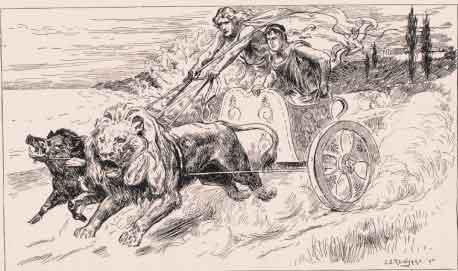
"No one shall have my daughter," said the old king, "until he proves that he is worthy to be my son-in-law. If you want her, you must come for her in a chariot drawn by a lion and a wild boar. If you come in any other way, she shall not be your wife." And Pelias laughed, and drove the young man out of his palace.

Admetus went away feeling very sad; for who had ever heard of harnessing a lion and a wild boar together in a chariot? The bravest man in the world could not do such a thing as that.

As he walked along and saw the sheep and goats feeding on the hilltops near his own town, he chanced to think of Apollo and of the last words that he had heard him say: "When you need my help, let me know."

"I will let him know," said Admetus.

Early the next morning he built an altar of stones in the open field; and when he had killed the fattest goat of the flock, he built a fire on the altar and laid the thighs of the goat in the flames. Then when the smell of the burning flesh went up into the air, he lifted his hands towards the mountain tops and called to Apollo.

"Lord of the Silver Bow," he cried, "if ever I have shown kindness to the poor and the distressed, come now and help me. For I am in sore need, and I remember your promise."

Hardly was he done speaking when bright Apollo, bearing his bow and his quiver of arrows, came down and stood before him.

"Kindest of kings," he said, "tell me how I can help you."

Then Admetus told him all about the fair Alcestis, and how her father would give her only to the man who should come for her in a chariot drawn by a lion and a wild boar.

"Come with me," said Apollo, "and I will help you."

Then the two went together into the forest, the Lord of the Silver Bow leading the way. Soon they started a lion from its lair and gave chase to it. The fleet-footed Apollo seized the beast by its mane, and although it howled and snapped with its fierce jaws it did not touch him. Then Admetus started a wild boar from a thicket. Apollo gave chase to it, too, making the lion run beside him like a dog. When he had caught the boar, he went on through the forest, leading the two beasts, one with his right hand, the other with his left; and Admetus followed behind.

It was not yet noon when they came to the edge of the woods and saw the sea and the city of Iolcus only a little way off. A golden chariot stood by the roadside as if waiting for them, and the lion and the boar were soon harnessed to it. It was a strange team, and the two beasts tried hard to fight each other; but Apollo lashed them with a whip and tamed them until they lost their fierceness and were ready to mind the rein. Then Admetus climbed into the chariot; and Apollo stood by his side and held the reins and the whip, and drove into Iolcus.

Old King Pelias was astonished when he saw the wonderful chariot and the glorious charioteer; and when Admetus again asked him for the fair Alcestis, he could not refuse. A day was set for the wedding, and Apollo drove his team back to the forest and set the lion and the wild boar free.

And so Admetus and Alcestis were married, and everybody in the two towns, except gruff old King Pelias, was glad. Apollo himself was one of the guests at the wedding feast, and he brought a present for the young bridegroom; it was a promise from the Mighty Folk upon the mountain top that if Admetus should ever be sick and in danger of death, he might become well again if some one who loved him would die for him.


III. THE SHADOW LEADER.

Admetus and Alcestis lived together happily for a long time, and all the people in their little kingdom loved and blessed them. But at last Admetus fell sick, and, as he grew worse and worse every day, all hope that he would ever get well was lost. Then those who loved him remembered the wedding gift which Apollo had given him, and they began to ask who would be willing to die in his stead.

His father and mother were very old and could hope to live but a short time at best, and so it was thought that one of them would be glad to give up life for the sake of their son. But when some one asked them about it, they shook their heads and said that though life was short they would cling to it as long as they could.

Then his brothers and sisters were asked if they would die for Admetus, but they loved themselves better than their brother, and turned away and left him. There were men in the town whom he had befriended and who owed their lives to him; they would have done everything else for him, but this thing they would not do.

Now while all were shaking their heads and saying "Not I," the beautiful Alcestis went into her own room and called to Apollo and asked that she might give up her life to save her husband. Then without a thought of fear she lay down upon her bed and closed her eyes; and a little while afterward, when her maidens came into the room they found her dead.

At the very same time Admetus felt his sickness leave him, and he sprang up as well and strong as he had ever been. Wondering how it was that he had been so quickly cured, he made haste to find Alcestis and tell her the good news. But when he went into her room, he saw her lying lifeless on her couch, and he knew at once that she had died for him. His grief was so great that he could not speak, and he wished that death had taken him and spared the one whom he loved.

In all the land every eye was wet with weeping for Alcestis, and the cries of the mourners were heard in every house. Admetus sat by the couch where his young queen lay, and held her cold hand in his own. The day passed, and night came, but he would not leave her. All through the dark hours he sat there alone. The morning dawned, but he did not want to see the light.

At last the sun began to rise in the east, and then Admetus was surprised to feel the hand which he held growing warm. He saw a red tinge coming into the pale cheeks of Alcestis.

A moment later the fair lady opened her eyes and sat up, alive and well and glad.

How was it that Alcestis had been given back to life?

When she died and left her body, the Shadow Leader, who knows no pity, led her, as he led all others, to the cheerless halls of Proserpine, the queen of the Lower World.

"Who is this who comes so willingly?" asked the pale-faced queen.

And when she was told how Alcestis, so young and beautiful, had given her life to save that of her husband, she was moved with pity; and she bade the Shadow Leader take her back again to the joy and sunlight of the Upper World.

So it was that Alcestis came to life; and for many years she and Admetus lived in their little kingdom not far from the sea; and the Mighty Ones on the mountain top blessed them; and, at last, when they had become very old, the Shadow Leader led them both away together.

▬▬▬▬▬▬▬▬▬▬▬▬
► An Informative Page ◄
▬▬▬▬▬▬▬▬▬▬▬▬

The Five Boons of Life by Mark Twain ( Short Story )


posted by Di-G on

No comments


The Five Boons of Life by Mark Twain ( Short Story ) 


In the morning of life came a good fairy with her basket, and said:

"Here are gifts. Take one, leave the others. And be wary, chose wisely; oh, choose wisely! for only one of them is valuable."

The gifts were five: Fame, Love, Riches, Pleasure, Death. The youth said, eagerly:

"There is no need to consider"; and he chose Pleasure.

He went out into the world and sought out the pleasures that youth delights in. But each in its turn was short-lived and disappointing, vain and empty; and each, departing, mocked him. In the end he said: "These years I have wasted. If I could but choose again, I would choose wisely.

The fairy appeared, and said:

"Four of the gifts remain. Choose once more; and oh, remember-- time is flying, and only one of them is precious."

The man considered long, then chose Love; and did not mark the tears that rose in the fairy's eyes.

After many, many years the man sat by a coffin, in an empty home. And he communed with himself, saying: "One by one they have gone away and left me; and now she lies here, the dearest and the last. Desolation after desolation has swept over me; for each hour of happiness the treacherous trader, Love, as sold me I have paid a thousand hours of grief. Out of my heart of hearts I curse him."

"Choose again." It was the fairy speaking.

"The years have taught you wisdom--surely it must be so. Three gifts remain. Only one of them has any worth--remember it, and choose warily."

The man reflected long, then chose Fame; and the fairy, sighing, went her way.

Years went by and she came again, and stood behind the man where he sat solitary in the fading day, thinking. And she knew his thought:

"My name filled the world, and its praises were on every tongue, and it seemed well with me for a little while. How little a while it was! Then came envy; then detraction; then calumny; then hate; then persecution. Then derision, which is the beginning of the end. And last of all came pity, which is the funeral of fame. Oh, the bitterness and misery of renown! target for mud in its prime, for contempt and compassion in its decay."

"Chose yet again." It was the fairy's voice.

"Two gifts remain. And do not despair. In the beginning there was but one that was precious, and it is still here."

"Wealth--which is power! How blind I was!" said the man. "Now, at last, life will be worth the living. I will spend, squander, dazzle. These mockers and despisers will crawl in the dirt before me, and I will feed my hungry heart with their envy. I will have all luxuries, all joys, all enchantments of the spirit, all contentments of the body that man holds dear. I will buy, buy, buy! deference, respect, esteem, worship--every pinchbeck grace of life the market of a trivial world can furnish forth. I have lost much time, and chosen badly heretofore, but let that pass; I was ignorant then, and could but take for best what seemed so."

Three short years went by, and a day came when the man sat shivering in a mean garret; and he was gaunt and wan and hollow-eyed, and clothed in rags; and he was gnawing a dry crust and mumbling:

"Curse all the world's gifts, for mockeries and gilded lies! And miscalled, every one. They are not gifts, but merely lendings. Pleasure, Love, Fame, Riches: they are but temporary disguises for lasting realities--Pain, Grief, Shame, Poverty. The fairy said true; in all her store there was but one gift which was precious, only one that was not valueless. How poor and cheap and mean I know those others now to be, compared with that inestimable one, that dear and sweet and kindly one, that steeps in dreamless and enduring sleep the pains that persecute the body, and the shames and griefs that eat the mind and heart. Bring it! I am weary, I would rest."

The fairy came, bringing again four of the gifts, but Death was wanting. She said:

"I gave it to a mother's pet, a little child. It was ignorant, but trusted me, asking me to choose for it. You did not ask me to choose."

"Oh, miserable me! What is left for me?"

"What not even you have deserved: the wanton insult of Old Age."

▬▬▬▬▬▬▬▬▬▬▬▬
► An Informative Page ◄
▬▬▬▬▬▬▬▬▬▬▬▬